
Quantum mechanics has a reputation for being random. Dice rolls at the heart of reality, God playing games, and so on. But the full story is stranger: for most of its life, a quantum system is not random at all. The randomness shows up only at one particular moment.
The old dream of a predictable universe
In classical physics, a complete description of the world meant knowing where every object was and how fast it was moving. Give Newton’s laws that starting information and they hand you the whole future: where a planet will be, where a cannonball will land.
Then physicists started looking at atoms, and that confidence fell apart. Particles at that scale don’t have a neat position and speed that you can track together. It looked as if prediction itself might be impossible down there.
It isn’t. Quantum mechanics changed what gets predicted.
What a quantum system actually is
In quantum mechanics, a system is described by a wave function. You can think of it as a list of possibilities, each with a number attached (called an amplitude) that says how strongly that possibility is present. An electron isn’t secretly at one location; its wave function is spread across many possible locations at once. This blend of possibilities is called a superposition.
Here is the surprising part. The wave function changes over time according to a precise rule, the Schrödinger equation:
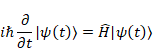
You can skip the equation. It says that if you know the wave function now, and you know the forces acting on the system, then you can calculate the wave function at any later time.
There are no dice in that rule. If you know the wave function today, you know it exactly tomorrow. The system flows smoothly and predictably, not as a single point on a path, but as a whole landscape of possibilities changing together.
Where the randomness comes in
The dice appear when you measure.
When you check where the electron is, you never see the smeared-out blend. You find it in one place. The wave function gave you the odds, and nature picked one outcome. The recipe for those odds is the Born rule:

In words: the probability of an outcome is the strength of its amplitude, squared. If one possibility has an amplitude with squared strength 0.8, you will see it about 80% of the time.
So quantum physics has two very different phases:
- Between measurements: smooth, continuous, fully predictable.
- At measurement: one outcome appears, and which one is only a matter of probability.
(Strictly speaking, this “collapse” picture is how the standard textbook account describes measurement. Some interpretations, like Many-Worlds, say nothing ever collapses. We’ll come back to that.)
The double-slit lesson
The classic example is the double-slit experiment. Fire electrons one at a time at a barrier with two narrow openings, and record where each one lands on a screen behind it.
Quantum mechanics cannot tell you where any single electron will land. But it predicts, with astonishing precision, the pattern that builds up after thousands of electrons: bands of high and low density called an interference pattern. Each dot looks random. The overall picture is not.
That is the deal quantum mechanics offers. It gives up on predicting individual events and gains near-perfect prediction of the statistics.
Not ignorance, but something deeper?
Take a coin flipped into the air. At every instant it is really heads-up or tails-up. Probability only reflects our ignorance of the exact forces involved. With perfect information, you could predict the result.
In standard quantum theory, it’s different. An unmeasured quantum bit isn’t secretly 0 or 1, waiting for us to look. It is genuinely in a blend of both. The probability seems to be built into nature itself rather than into our lack of knowledge.
Whether that reading is the final truth is still debated. Some interpretations of quantum mechanics treat the probabilities as reflecting incomplete knowledge after all. But the standard picture takes quantum randomness as real.
|
|
Classical physics |
Quantum physics |
|
What describes a system |
Exact position and speed |
A wave function (a blend of possibilities) |
|
How it changes |
Along a definite path |
The blend evolves smoothly and predictably |
|
What probability means |
Our lack of information |
In the standard view, built into nature |
|
Effect of measuring |
Ideally none |
Gives one outcome and changes the state |
Why this changed everything
Physics shifted its goal from tracking individual things to tracking the evolving space of possibilities. That shift turned out to be enormously productive. It underlies how transistors work, why atoms bond into molecules, how lasers produce their light, and why some materials conduct electricity with no resistance at all.
Quantum mechanics didn’t conquer microscopic unpredictability by forcing it into Newton’s mold. It wrote new laws for how the probabilities themselves behave.
But there’s a catch
If a quantum system really is in a blend of possibilities, and measurement picks just one, a puzzle follows. What counts as a “measurement”? Why does a tiny electron happily exist in two places at once while a cat, a chair, or you never do?
You have never seen a cat that is both alive and dead. Quantum mechanics says such a blend should be possible in principle. So where did it go?
The answer involves something that is happening constantly, to everything around you, whether or not anyone is watching. Physicists call it decoherence. It explains why the quantum world hides itself so effectively, and it takes us surprisingly far toward solving the puzzle, though not all the way.
Next time: why Schrödinger’s cat is never both alive and dead.

Comments
No comments yet.
Leave a comment